Table of Contents
ToggleWhen Persona 5 first launched on PlayStation in 2016, Nintendo fans could only watch from the sidelines as one of the decade’s best JRPGs became a cultural phenomenon. Fast forward to 2022, and the wait finally ended when Persona 5 Royal landed on Switch, breaking the series’ long PlayStation exclusivity. Now in 2026, Royal remains one of the most compelling RPG experiences you can take on the go, combining stylish turn-based combat with deep social sim mechanics that’ll consume 100+ hours before you realize it. Whether you’re a JRPG veteran curious about what you missed or a Switch owner wondering if this port holds up, this guide covers everything from performance comparisons to beginner tips that’ll help you navigate Tokyo’s Metaverse without wasting precious in-game time.
Key Takeaways
- Persona 5 Nintendo Switch arrived in October 2022 with no meaningful compromises, running at native 1080p docked with stable 30 FPS and including all DLC costumes and Personas free.
- The game demands 100+ hours and masterful time management through its calendar system, forcing you to prioritize between Palace infiltrations, Confidant relationships, and social stat grinding.
- Persona 5 Royal’s turn-based combat rewards exploiting enemy weaknesses and chaining Baton Pass attacks, while the social simulation half delivers exceptional character development that equals its gameplay depth.
- New players should prioritize maxing Kawakami and Yoshida early for crucial time-saving and progression bonuses, and complete Palaces in single days to maximize time for other activities.
- The Switch’s handheld mode offers 4-5 hours of battery life with perfectly readable UI at 720p, making Persona 5 Royal the most flexible way to experience this stylish JRPG outside of PlayStation.
What Is Persona 5 and Why Is It So Popular?
Persona 5 is a turn-based JRPG developed by Atlus that follows a group of Tokyo high school students who moonlight as the Phantom Thieves, a crew that enters the cognitive world (the Metaverse) to steal the corrupted desires of evil adults. By day, you’re attending school, working part-time jobs, and building relationships. By night, you’re dungeon-crawling through Palaces, battling Shadows, and collecting Personas to fuse into more powerful demons.
What makes Persona 5 stand out isn’t just its flashy UI and acid jazz soundtrack, though those elements are iconic. It’s the way the game respects your time management choices. Every day presents limited actions, forcing you to prioritize social links (Confidants), stat boosts, or Palace infiltration. Miss a deadline and it’s game over. This risk-reward loop creates genuine tension rarely found in modern RPGs.
The game sold over 5 million copies worldwide before Royal even launched, and critical acclaim was near-universal. Players praised its sharp social commentary on Japanese society, memorable cast (Ryuji, Ann, Makoto, and crew became instant favorites), and combat depth that rewards exploiting enemy weaknesses. It wasn’t just a great JRPG, it became a gateway title that pulled in players who’d never touched the genre.
The History of Persona 5 on Nintendo Switch
From PlayStation Exclusive to Multi-Platform Release
For years, Persona 5 was locked to PlayStation platforms, PS3 and PS4 initially, then PS5 via backward compatibility. Atlus and Sega maintained radio silence on ports even though constant fan requests. Nintendo fans watched competitors enjoy one of gaming’s most stylish RPGs while the Switch library grew with indie darlings but lacked major third-party JRPG exclusives of this caliber.
That changed during the June 2022 Xbox & Bethesda Games Showcase when Atlus shocked everyone by announcing Persona 5 Royal for Switch, Xbox, and PC. The announcement trailer dropped casually, confirming an October 21, 2022 release date across all platforms simultaneously. After six years of PlayStation exclusivity, the Phantom Thieves were finally going portable in a way the Vita port never materialized.
Persona 5 Strikers: The First Taste for Switch Players
Technically, Persona 5 Strikers hit Switch first in February 2021. This Omega Force-developed musou spinoff served as a direct sequel to the original Persona 5, featuring Dynasty Warriors-style combat instead of turn-based battles. Strikers proved the Switch could handle Persona’s art style and gave Nintendo fans their first canonical Phantom Thieves experience.
But, Strikers assumed you’d already played Persona 5, spoiling major plot points within the first hour. It was a weird entry point, imagine jumping into a sequel without context. Performance was serviceable but not stellar, with frame drops in crowded battles. Still, it sold well enough to signal demand for the mainline game.
Persona 5 Royal Arrives on Switch in 2022
When Persona 5 Royal launched on October 21, 2022, it was the definitive edition Switch owners had been waiting for. This wasn’t a half-baked port, Atlus included all DLC costumes, Personas, and challenge battles from the PS4 version. The $59.99 price tag matched other platforms, though physical copies became collector’s items due to limited print runs in certain regions.
Reviews praised the port’s stability. GameSpot noted minimal compromises in their technical analysis, while players on forums celebrated finally experiencing the game without buying a PlayStation. Sales data from late 2022 showed Royal performing exceptionally well on Switch, often charting higher than Xbox or PC versions in weekly sales.
Persona 5 Royal vs. Original Persona 5: What’s the Difference?
New Characters, Story Content, and Palace
If you played the original Persona 5 on PS4, Royal adds roughly 30 hours of new content. The biggest addition is Kasumi Yoshizawa, a first-year gymnast at Shujin Academy who becomes a Confidant early but joins the Phantom Thieves much later. Her story arc ties directly into the new third semester, an entirely new story segment that triggers if you max certain Confidants before November.
Takuto Maruki, the school counselor, is the other major addition. His Confidant must reach rank 9 by November 17 to unlock the third semester. Maruki’s Palace represents the emotional climax many felt the original ending lacked, exploring themes of trauma, acceptance, and the cost of a perfect world. It’s not just bonus content, it reframes the entire narrative.
Royal also adds Kichijoji, a new Tokyo district with a jazz club (boosts Confidant points), darts and billiards mini-games (boost Baton Pass ranks), and a used goods shop. These aren’t throwaway locations, they integrate into the social sim loop with meaningful gameplay benefits.
Enhanced Gameplay Mechanics and Quality of Life Improvements
Royal isn’t just more content: it’s a refined experience. Baton Pass now works from the start with all party members instead of requiring Confidant ranks. Showtimes, flashy tag-team attacks between specific character pairs, trigger randomly during battle for massive damage. Traits add another layer to Persona fusion, granting passive abilities like increased elemental damage or better status effect rates.
Quality of life improvements matter more than you’d think. Mementos (the procedurally generated dungeon) now has collectible stamps that unlock permanent bonuses like increased money or experience. You can access it more freely without Morgana blocking you. Guns reload after each battle instead of once per Palace visit, making firearms actually useful. Technical damage (exploiting ailments) was buffed significantly, rewarding status effect strategies.
The game’s difficulty balance also shifted. Normal mode in Royal is slightly easier than the original due to these mechanics, but new difficulty options (including a Safety mode that removes failure conditions) make it accessible to players who just want the story.
How Persona 5 Royal Performs on Nintendo Switch
Graphics and Visual Fidelity Comparison
Persona 5 Royal on Switch renders at 1920×1080 docked and 1280×720 in handheld mode. The PS4 version ran at 1080p, so you’re getting native resolution when docked, no upscaling tricks. Textures remain sharp, and the game’s cel-shaded art style ages gracefully, meaning visual downgrades are minimal. Character models, UI elements, and that signature red-and-black aesthetic look nearly identical across platforms.
That said, the Switch version uses slightly lower-quality shadows and ambient occlusion compared to PS5 (which runs the PS4 version via back-compat). In side-by-side comparisons, PS5 has marginally better anti-aliasing. But unless you’re pixel-peeping, you won’t notice. The stylized graphics prioritize art direction over raw fidelity, which plays to the Switch’s strengths. Many players who’ve compared both versions for RPG Site coverage noted the differences are negligible during actual gameplay.
Frame Rate and Load Times
Royal targets 30 FPS on Switch and mostly hits it. Frame drops are rare, usually when multiple particle effects fire during All-Out Attacks or in crowded Shibuya scenes. Nothing that disrupts gameplay. The PS4 version also ran at 30 FPS, so you’re not losing performance parity.
Load times are where the Switch version stumbles slightly. Fast-traveling between locations takes 8-12 seconds on Switch compared to 5-7 seconds on PS5 with its SSD. Palace entrances and battle transitions load in 6-10 seconds. It’s noticeable if you’re coming from a PS5, but not a dealbreaker. The original PS4 version had similar load times, so it’s not a Switch-specific issue, more a limitation of the game’s engine.
Patches since launch (the game’s currently on version 1.0.3 as of early 2026) haven’t drastically improved load times, but stability patches fixed rare crashes some players experienced during specific cutscenes in late-game Palaces.
Handheld vs. Docked Mode Experience
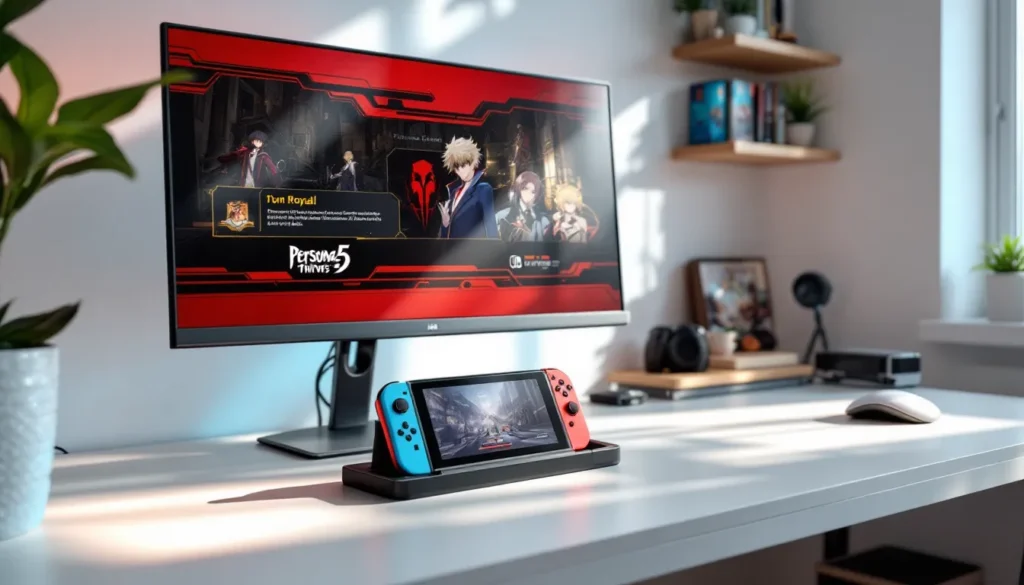
Handheld mode is where Royal on Switch truly shines. The 720p resolution looks crisp on the Switch’s 6.2-inch screen, and the UI, designed for TV viewing, remains perfectly readable. Text size in menus, battle prompts, and dialogue boxes doesn’t require squinting. Battery life averages 4-5 hours depending on brightness settings, which is solid for a graphically detailed JRPG.
Playing docked on a TV emphasizes the visual fidelity, and the game runs identically whether docked or portable. Some players report preferring handheld for the social sim sections (reading through dialogue and menus) while docking for intense Palace runs and boss fights. The flexibility is unmatched, no other platform lets you grind Mementos on a commute then switch to your TV for the big story moments.
What to Expect: Gameplay and Story Overview
Turn-Based Combat and the Persona System
Combat in Persona 5 revolves around the Press Turn System, exploit an enemy’s weakness (via elemental spells, physical types, or status ailments) and you earn a 1 More, letting that character act again. Chain weaknesses across your party, then trigger an All-Out Attack for massive AOE damage and a stylish finisher animation. Boss fights disable this cheese to some extent, but random encounters reward knowing enemy resistances.
Personas are demons you capture (or “negotiate” with) after knocking them down. You can carry multiple Personas, switching mid-battle to adapt to enemy types. The Velvet Room lets you fuse Personas to create stronger ones, inheriting skills and traits. Fusion is deep, min-maxers spend hours crafting perfect Personas with maxed stats, no weaknesses, and stacked skills like Charge + Megidolaon for absurd damage.
Party composition matters. Early on, you’re stuck with Ryuji (physical/electric), Ann (fire/healing), and Morgana (wind/healing). Later additions like Makoto (nuclear/defense buffs) and Haru (psy/gun skills) offer versatility. You can’t control AI partners unless you adjust settings, default is “Act Freely,” but switching to “Direct Commands” is essential for harder difficulties.
Social Simulation and Confidant Relationships
Outside combat, you’re managing a calendar. Each day offers limited time slots, after school, evening, and every action (hanging with friends, studying, working jobs) consumes time. Confidants are social links with party members, side characters, and key NPCs. Ranking them up unlocks gameplay bonuses: Kawakami (your teacher) lets you leave class to craft tools, Takemi (the doctor) offers better healing items, and Yoshida (the politician) boosts negotiation success rates.
Confidants also gate story content. Max out Kasumi and Maruki before November, and you unlock the third semester. Ignore them, and you get the original ending. The game never explicitly tells you this, it’s easy to miss if you’re not following a guide.
Romance is optional but popular. You can date one (or multiple) female Confidants, though dating everyone leads to a brutal Valentine’s Day scene where they all find out. The game doesn’t punish you mechanically, but the emotional guilt trip is real. Building social stats, Knowledge, Guts, Proficiency, Kindness, Charm, is required to unlock certain Confidants, adding another layer of time management. If you’re juggling Palace deadlines, Confidant hangouts, and stat grinding, something’s gotta give.
The social sim half isn’t filler, it’s where character development happens. Party members grow beyond their archetypes (the hot-headed jock, the isolated genius, the sheltered rich girl), and side characters like Sojiro (your guardian) deliver some of the game’s most touching moments. Many players who discover other Nintendo Switch titles after finishing Royal cite the Confidant system as a gold standard for character writing in games.
Should You Buy Persona 5 Royal on Nintendo Switch in 2026?
Who Will Enjoy This Game?
Persona 5 Royal is a 100+ hour commitment, and it demands your attention. If you’re someone who bounces between games or prefers 10-hour indie experiences, this might not be the right fit. But if you love deep RPG systems, character-driven narratives, and games that respect your choices, Royal is essential.
You’ll love it if you:
- Enjoy turn-based combat with strategic depth (think SMT, Dragon Quest, or classic Final Fantasy)
- Don’t mind reading, there’s a ton of dialogue, and it’s fully voiced in English and Japanese
- Appreciate games that balance gameplay with storytelling (neither side feels like an afterthought)
- Want a portable JRPG that doesn’t compromise on scope or content
You might struggle if you:
- Need fast-paced action (this is methodical, menu-driven combat)
- Dislike time management mechanics (missing deadlines = game over, no second chances)
- Prefer open-world exploration over linear dungeon crawling
- Get frustrated by anime tropes (some characters lean into archetypes early on, though they develop past them)
The game’s tone shifts between lighthearted slice-of-life (going to the movies, eating ramen) and dark subject matter (abuse, suicide, corruption). It handles heavy themes with surprising maturity, but the tonal whiplash can feel jarring. One day you’re infiltrating a Palace to stop a sexual predator, the next you’re fishing for a giant koi. It works, but it’s divisive.
Pricing and Where to Find Deals
Persona 5 Royal on Switch retails for $59.99 USD digitally on the eShop. Physical copies originally launched at the same price but are now harder to find, expect to pay $50-$70 depending on retailer and region. Sites like IGN occasionally cover eShop sales where Royal drops to $44.99 during major Nintendo sales events (Black Friday, summer sales).
In early 2026, you’ll sometimes catch it on sale for $39.99-$49.99. If you’re patient, waiting for a sale makes sense, the game’s been out nearly four years, and Atlus has run periodic discounts. Physical copies hold value well, so if you find one under $50, grab it. Resale prices for sealed copies have trended upward among collectors.
DLC costumes and Personas (originally $40+ worth) are included free in all versions, so you’re getting the complete package regardless of when you buy. No season passes, no microtransactions. Just a massive JRPG with all the bells and whistles.
Tips for New Players Starting Persona 5 Royal on Switch
Essential Beginner Tips to Master the Game
1. Play on Normal or Easy for your first run. Royal’s new mechanics make it more forgiving than the original, but the game still punishes mistakes. Hard mode ramps up enemy damage significantly, and Merciless (counterintuitively) makes the game easier for veterans since Technical/Weakness damage multipliers favor the player.
2. Max Kawakami (Temperance) and Yoshida (Sun) Confidants ASAP. Kawakami’s rank 10 ability lets you do nighttime activities after exploring Palaces/Mementos, essentially giving you extra time. Yoshida boosts money and experience from negotiations, speeding up progression.
3. Don’t sleep on Baton Pass and Technicals. Baton Pass increases damage with each pass, chaining three weaknesses then passing to your heavy hitter for a boosted attack trivializes fights. Technicals (hitting a burned enemy with wind, a frozen enemy with physical) deal huge damage and are often overlooked.
4. Finish Palaces in one day. The game suggests multiple visits, but clearing a Palace in a single infiltration maximizes your remaining days for Confidants and social stats. Stock recovery items beforehand, and use Safe Rooms to fast-travel if you need to leave and return later.
5. Buy SP recovery accessories early. The Clinic (Takemi Confidant) sells SP Adhesive accessories that restore 7 SP per turn. They’re expensive early (100,000 yen at rank 7), but they’re game-changers. Grind money in Mementos or sell treasure items to afford them.
6. Always carry a Persona that matches your current Confidant’s Arcana. Having a matching Arcana Persona in your stock grants bonus points during Confidant hangouts, speeding up rank-ups. Fuse junk Personas just to have one of each Arcana on hand.
Time Management and Prioritizing Activities
The calendar system is Persona 5’s most stressful feature. You can’t do everything in one playthrough, accept that now. Prioritize Confidants that offer gameplay benefits over those that are purely story-focused. Here’s a rough priority list:
Must-Max Confidants (gameplay benefits):
- Kawakami (Temperance): Extra time at night
- Yoshida (Sun): Money/EXP boosts
- Takemi (Death): Discount healing items and SP accessories
- Mishima (Moon): EXP boosts for backup party members
- Maruki (Councillor) & Kasumi (Faith): Required for third semester (must hit rank 9 and 5, respectively, by November 17)
Nice-to-Have Confidants:
- Ryuji, Ann, Makoto, etc. (Party Members): Unlock combat abilities and ultimate Personas
- Chihaya (Fortune): Lets you boost Confidant affinity or social stats with money (expensive but efficient)
Social Stats Priority:
Aim for Charm 3 by early summer (unlocks Ann’s Confidant progression), Knowledge 3 by mid-summer (Makoto), and Guts 3 for Takemi. Study during class (pick correct answers for bonus points), work part-time jobs that boost stats, and eat at the diner in Shibuya for +3 Knowledge.
Don’t stress about romance choices, you can friend-zone everyone and still get full story content. If you do romance someone, the Christmas and Valentine’s events offer unique scenes, but they don’t impact gameplay. Players exploring other genres like FPS titles on Switch might find the lack of action-oriented reflexes here refreshing, Royal rewards planning over twitch skills.
Other Persona Games Available on Nintendo Switch
Royal isn’t the only Persona game on Switch. Atlus has slowly ported the modern entries, giving Nintendo fans access to nearly the entire modern series.
Persona 5 Strikers (February 2021) is the direct sequel, swapping turn-based combat for real-time action-RPG musou battles. It’s set six months after Royal’s original ending (not the third semester), so it works as a continuation if you skip that content. Strikers is shorter, around 40-50 hours, but the story’s solid, focusing on the Phantom Thieves’ summer road trip across Japan. Performance on Switch is weaker than Royal due to the real-time combat, with frame drops during crowded fights.
Persona 4 Golden hit Switch in January 2023, bringing the PS Vita classic to modern platforms. Golden is mechanically simpler than Royal, no Baton Pass, fewer QoL features, but the cast and small-town mystery vibe have a devoted fanbase. It’s also shorter (70-80 hours), making it more approachable. If you loved Royal and want more, Golden’s worth grabbing, especially during sales.
Persona 3 Portable also launched on Switch in January 2023 alongside Persona 4 Golden. P3P is the PSP version of Persona 3, offering a female protagonist route and visual novel-style exploration outside dungeons. It’s the oldest mechanically (no direct party control in some versions, though P3P fixes this), but the story, dealing with death and existentialism, is the series’ darkest and most affecting. Tartarus (the main dungeon) is a repetitive slog, but the narrative payoff is legendary among fans.
Atlus hasn’t announced Persona 6 yet, and rumors suggest it won’t launch before 2027 at the earliest. For now, Switch owners have access to three mainline Personas and one spinoff, plenty of content to keep you busy. If you finish Royal and crave more Atlus goodness, Shin Megami Tensei V is also on Switch and shares the Press Turn combat system, though it’s far more punishing and lacks the social sim elements. Players interested in hardware-focused content might also Switch teardown guides for technical deep-dives, though that’s a completely different angle from RPG gameplay.
Conclusion
Persona 5 Royal on Nintendo Switch isn’t just a great port, it’s the definitive way to experience one of the best JRPGs of the last decade if portability matters to you. The Switch version sacrifices nothing meaningful compared to PlayStation, running at native resolution with stable performance and all DLC included. Whether you’re grinding Mementos during a commute or immersing yourself in Palace infiltrations on your TV, Royal offers unmatched flexibility.
The 100+ hour runtime might intimidate, but the game’s pacing, character depth, and mechanical complexity justify the time investment. The calendar system creates tension and meaningful choice, the combat rewards strategic thinking over grinding, and the story tackles themes most games wouldn’t touch. If you’ve been on the fence or waiting for the right time to jump in, 2026 is as good as any, the game’s aged beautifully, and the community remains active with guides, builds, and discussions.
For new players, start on Normal, prioritize time-saving Confidants, and don’t stress about perfection. You won’t see everything in one playthrough, and that’s okay. For veterans coming from PlayStation, the portability alone justifies double-dipping. Either way, the Phantom Thieves are ready to steal your heart all over again.